

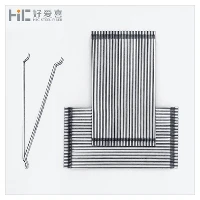

Hey there, fellow construction enthusiasts! I'm a supplier of Hooked End Type Steel Fiber, and today, I'm gonna dive into a hot topic: how does Hooked End Type Steel Fiber stack up against synthetic fibers in concrete applications? Let's break it down and see which one comes out on top.
What Are Hooked End Type Steel Fibers and Synthetic Fibers?
First things first, let's get a clear understanding of what we're talking about. Hooked End Type Steel Fibers are, well, steel fibers with hooked ends. These hooks are crucial as they help the fibers anchor themselves firmly within the concrete matrix. You can check out our Loose Hooked End Steel Fiber and High Strength Hooked End Steel Fiber for more details.

On the other hand, synthetic fibers are made from various polymers like polypropylene, nylon, or polyester. They're lightweight and come in different shapes and sizes. They've been gaining popularity in the construction industry for a while now.
Strength and Durability
When it comes to strength, Hooked End Type Steel Fibers are in a league of their own. The steel material itself is incredibly strong, and the hooked ends provide excellent bonding with the concrete. This results in a significant increase in the concrete's flexural and tensile strength. In high - stress applications like industrial floors, bridge decks, and precast elements, steel fibers can prevent cracking and extend the lifespan of the concrete structure.
Synthetic fibers, while they do add some strength to the concrete, don't offer the same level of reinforcement as steel fibers. They're more effective in controlling plastic shrinkage cracks that occur during the early stages of concrete curing. But when it comes to withstanding heavy loads and long - term stress, steel fibers take the lead.
Fire Resistance
Fire is a major concern in construction. Hooked End Type Steel Fibers have excellent fire resistance. Steel doesn't burn or melt easily, and it maintains its strength even at high temperatures. In the event of a fire, concrete reinforced with steel fibers is less likely to spall, which can save lives and reduce damage to the structure.
Synthetic fibers, however, have a lower melting point. When exposed to high temperatures, they can melt, leaving voids in the concrete. This can lead to spalling and a significant reduction in the concrete's structural integrity. So, if fire safety is a top priority, steel fibers are the way to go.

Cost - Effectiveness
At first glance, Hooked End Type Steel Fibers might seem more expensive than synthetic fibers. But when you consider the long - term benefits, they can actually be more cost - effective. Steel - reinforced concrete has a longer lifespan, which means less frequent repairs and replacements. Also, the increased strength and durability can reduce the need for additional reinforcement, saving on overall construction costs.
Synthetic fibers are cheaper upfront, but if the concrete structure requires more maintenance or has a shorter lifespan, the long - term costs can add up. So, in the grand scheme of things, steel fibers can offer better value for money.
Workability
Workability is an important factor in concrete applications. Hooked End Type Steel Fibers can slightly reduce the workability of concrete, especially if the fiber dosage is high. However, with proper mix design and the use of superplasticizers, this issue can be minimized.
Synthetic fibers generally have a less significant impact on workability. They can be easily dispersed in the concrete mix, and they don't cause as much balling or clumping as steel fibers can. But again, this depends on the type and dosage of the fibers used.

Environmental Impact
From an environmental perspective, Hooked End Type Steel Fibers have their advantages. Steel is a recyclable material, and using steel fibers in concrete can contribute to sustainable construction practices. Many steel fibers are made from recycled steel, which reduces the demand for new raw materials.
Synthetic fibers are made from polymers, which are derived from non - renewable resources. While some synthetic fibers can be recycled, the process is often more complex and less efficient compared to steel recycling. So, if you're looking for a more environmentally friendly option, steel fibers are a good choice.

Applications
Hooked End Type Steel Fibers are widely used in heavy - duty applications such as Steel Fibres for Concrete Reinforcement. They're ideal for structures that need to withstand high loads, like industrial warehouses, parking garages, and airport runways.
Synthetic fibers are commonly used in residential and light - commercial applications, such as sidewalks, driveways, and interior floors. They're great for controlling shrinkage cracks and improving the surface finish of the concrete.
Conclusion
So, there you have it! Hooked End Type Steel Fibers and synthetic fibers both have their pros and cons. But in most high - performance and heavy - duty concrete applications, steel fibers come out on top. They offer superior strength, fire resistance, and long - term durability. And when you consider the environmental benefits and cost - effectiveness, they're a smart choice for any construction project.
If you're in the market for Hooked End Type Steel Fibers for your next concrete project, I'd love to have a chat with you. Whether you need more information about our products or want to discuss your specific requirements, don't hesitate to reach out. Let's work together to make your construction project a success!
References
- ACI Committee 544. (Year). Fiber - Reinforced Concrete. American Concrete Institute.
- Malhotra, V. M., & Mehta, P. K. (Year). Concrete: Structure, Properties, and Materials. McGraw - Hill.
- Neville, A. M. (Year). Properties of Concrete. Pearson Education.