

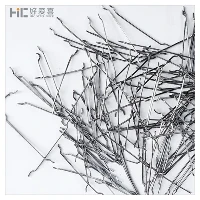

Hey there! As a supplier of Glued Steel Fibres, I often get asked about the diameter range of these nifty little guys. So, I thought I'd sit down and write a blog post to clear up some of that confusion.
First off, let's talk a bit about what glued steel fibres are and why they're so important. Glued steel fibres are, well, steel fibres that are glued together in bundles. They're used to reinforce concrete and other construction materials, making them stronger and more durable. When you mix these bundled fibres into your concrete, the glue dissolves during the mixing process, and the individual fibres are released, spreading throughout the concrete to provide reinforcement.
Now, onto the diameter range. The diameter of glued steel fibres can vary quite a bit, depending on the specific application and the desired properties of the reinforced material. Generally speaking, the diameter of glued steel fibres falls within the range of 0.2 mm to 1.2 mm. Let's break down what this means and how different diameters can influence the performance of your construction projects.
Small - diameter Glued Steel Fibres (0.2 mm - 0.5 mm)
Small - diameter glued steel fibres have a few distinct advantages. First of all, they offer excellent dispersion in the concrete matrix. Because they're so thin, they can spread out more evenly throughout the concrete, providing a more uniform reinforcement. This is especially important in applications where a high degree of crack control is required.
For example, in industrial flooring or thin - walled concrete structures, small - diameter fibres can help prevent the formation of early - age shrinkage cracks. They work by bridging the micro - cracks that start to form as the concrete dries and hardens, stopping them from growing into larger, more serious cracks. You can find some great products for such applications on our Reinforced Concrete Steel Fiber page.
Another benefit of small - diameter fibres is that they can enhance the ductility of the concrete. Ductility refers to the ability of a material to deform under stress without breaking. In concrete, this means that the material can absorb more energy before it fails, which is crucial in earthquake - prone areas or structures that may experience impact loading.
Medium - diameter Glued Steel Fibres (0.5 mm - 0.8 mm)
Medium - diameter glued steel fibres strike a nice balance between dispersion and strength. They're not as thin as the small - diameter fibres, but they still offer good distribution in the concrete. These fibres are often used in applications where you need a combination of crack control and increased flexural strength.
In precast concrete elements, for example, medium - diameter glued steel fibres can improve the handling and transportation of the elements. They help make the concrete more resistant to the stresses involved in lifting and moving precast parts. Also, they can enhance the long - term durability of the precast structures, reducing the risk of cracking and deterioration over time. If you're interested in using these types of fibres for precast applications, check out our Reinforced Concrete Steel Fiber options.
Large - diameter Glued Steel Fibres (0.8 mm - 1.2 mm)
Large - diameter glued steel fibres are all about strength. They're thicker and can provide a greater load - bearing capacity to the concrete. These fibres are typically used in heavy - duty applications, such as in bridge decks, high - rise building foundations, and industrial structures that will be subjected to high levels of stress.
In bridge decks, for instance, large - diameter glued steel fibres can help resist the repetitive loading from traffic. They can also improve the abrasion resistance of the deck surface, protecting it from the wear and tear caused by vehicles. And in high - rise building foundations, they can enhance the overall stability and load - carrying capacity of the structure. You can learn more about these high - strength solutions on our Glued Steel Fiber page.
Factors Affecting the Choice of Diameter
When it comes to choosing the right diameter of glued steel fibres for your project, there are a few factors you need to consider.
- Concrete Mix Design: The type of concrete mix you're using can influence the choice of fibre diameter. For example, if your concrete has a high slump (more fluid), smaller - diameter fibres may disperse more easily. On the other hand, if you're using a low - slump, more stiff mix, larger - diameter fibres may be more suitable.
- Application Requirements: As we've discussed, different applications have different requirements. If you need excellent crack control, small - diameter fibres are a good bet. But if you're looking for high - strength reinforcement, you'll probably want to go with larger - diameter fibres.
- Cost Considerations: Generally, larger - diameter fibres are more cost - effective on a per - unit - strength basis. However, you also need to factor in the overall cost of the project, including the cost of mixing and placing the concrete with the fibres.
As a supplier, I'm here to help you make the right choice for your project. Whether you're working on a small residential job or a large commercial development, we have a wide range of glued steel fibres with different diameters to meet your needs.
If you're still not sure which diameter is best for you, or if you have any other questions about our glued steel fibres, don't hesitate to reach out. We're always happy to have a chat and discuss your specific requirements. Just drop us a line, and we can start a conversation about how our products can benefit your construction project.
Let's get the ball rolling on your next big project and ensure that your concrete is as strong and durable as possible. Contact us today to start discussing your glued steel fibre requirements, and let's work together to find the perfect solution for you.


References
- Neville, A.M. "Properties of Concrete", 5th Edition. Pearson Education Limited, 2011.
- ACI Committee 544. "State - of - the - Art Report on Fiber Reinforced Concrete". American Concrete Institute, 1996.