


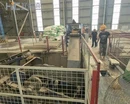
The working principle of the steel fiber automatic distributor is to realize quantitative delivery, uniform dispersion and precise addition of steel fiber through the synergy of mechanical structure and automatic control. The core process includes storage and transportation, dispersion treatment, metering control and linkage addition. The details are as follows:
1. Storage and transportation: ensure a continuous supply of steel fiber
The equipment is usually equipped with a storage bin (such as a hopper or a tank) for storing bagged or bulk steel fiber. The steel fiber is uniformly transported from the storage bin to the dispersion unit through a screw conveyor, a vibrating feeder or a belt conveyor. For example, the screw conveyor pushes the fiber forward by rotating the screw to avoid blockage; the vibrating feeder loosens the fiber through high-frequency vibration to meet the transportation needs of steel fibers of different shapes (straight, hook-shaped).
2. Dispersion treatment: break the fiber agglomeration and achieve uniform distribution
This is the core link. The electrostatic adsorption or mechanical entanglement between steel fibers is destroyed by mechanical force (vibration, shearing, centrifugation, etc.), and the "fiber ball" is dispersed into a single or small bundle state. Common dispersion mechanisms include:
Vibration screening dispersion: The fibers pass through multiple layers of vibrating screens, and the high-frequency vibration of the screens (amplitude 0.5-2mm, frequency 50-60Hz) is used to separate the agglomerated fibers and screen out impurities at the same time;
High-speed shear dispersion: The fibers enter the high-speed rotating dispersion chamber (speed 1000-3000r/min), and the fibers are broken up by the shear force of the blades or the vortex of the airflow;
Airflow dispersion: The fibers are impacted by high-pressure airflow (wind pressure 0.3-0.6MPa), combined with the guide plate to form turbulence, realizing the integration of dispersion and transportation.
3. Metering control: Accurately adjust the amount of addition
The flow rate of the dispersed steel fibers is monitored in real time through a weighing sensor or a volumetric metering device, and the conveying speed is automatically adjusted in combination with the PLC control system and the set ratio (such as 0.5%-2% steel fiber content in concrete). For example:
Weighing and metering: Set up a dynamic weighing module in the conveying path. When the fiber weight reaches the set value, the valve or conveyor is triggered to start and stop;
Volume measurement: calculate the volume through the pitch, speed and conveying time of the screw conveyor, and indirectly control the fiber amount, which is suitable for continuous production scenarios.
4. Linkage addition: work in coordination with the mixing system
The dispersed steel fiber is added to the mixer synchronously according to the mixing cycle through a pipe or chute under the command of the control system (such as linkage with the mixer PLC). Some equipment is equipped with pneumatic valves or star dischargers to ensure that the fiber is evenly added during the mixing process to avoid secondary agglomeration caused by concentrated addition. For example, when the mixer enters the dry mixing stage, the distributor starts the addition program, and the fiber is mixed synchronously with the aggregate to improve the dispersion uniformity.
Key technical features
Anti-blocking design: The bottom of the storage bin adopts a conical structure + vibration device, and the inner wall of the conveying pipe is smooth (such as stainless steel material) to avoid fiber retention;
Adaptive adjustment: The sensor detects fiber humidity, density and other parameters, automatically adjusts the vibration frequency or conveying speed to adapt to the physical characteristics of different batches of steel fibers;
Closed-loop control: Real-time feedback of the deviation between the actual addition amount and the set value, and dynamic correction through the PID algorithm to ensure measurement accuracy (error ≤±1%).
Through the above process, the steel fiber automatic distributor can efficiently solve the problems of uneven dispersion, inaccurate measurement, and low efficiency of manual addition, and provide a stable guarantee for the industrial production of steel fiber concrete.


