


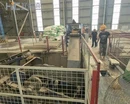
Steel fiber automatic dispenser is a special equipment used to achieve automatic, uniform dispersion and quantitative addition of steel fiber in the production process of concrete and other mixed materials. Its core function is to solve the problem of "fiber ball" agglomeration when steel fiber is directly put into the mixer in bags. The steel fiber is evenly dispersed through the dispersion mechanism and then sent to the mixing system to ensure that the steel fiber is evenly distributed in the concrete, thereby improving the material's crack resistance, wear resistance and other properties.
Main advantages
1. Excellent dispersion effect and improved material performance
Through dispersion mechanisms such as vibration, shearing or centrifugation (such as vibrating dispersion screen, high-speed shearing dispersion head, etc.), the steel fiber agglomeration is effectively broken and evenly distributed in the concrete, avoiding the problem of uneven fiber dispersion caused by traditional manual addition, and significantly enhancing the flexural strength, toughness and durability of concrete.
2. Improve production efficiency and reduce labor costs
Achieve automatic quantitative distribution of steel fiber, without manual splitting of packaging or dispersion of fibers, and reduce manual operation time. For example, the dispersion capacity of some equipment can reach more than 40 kilograms per minute. It can be directly matched with forced mixers to meet the needs of industrial continuous production.
3. Accurately control the proportion to ensure the quality of the project
Some equipment has weighing or volumetric measurement functions, which can accurately control the amount of steel fiber added to ensure the stability of the concrete mix ratio and avoid errors caused by manual addition. It is especially suitable for projects with extremely high material performance requirements, such as RPC (reactive powder concrete).
4. Reduce equipment loss and extend mechanical life
Through pre-dispersion treatment, the wear of undispersed fiber balls on mixer blades and other components is reduced, while avoiding uneven mixing or equipment jamming caused by fiber agglomeration.
5. Adapt to a variety of scenarios and is easy to operate
The equipment is flexibly designed, allowing for adjustments to dispersion parameters (such as motor speed and dispersion time) according to project requirements. It is suitable for various types of steel fibers (including straight and hook-shaped) and different mixer capacities. Some models use stainless steel casings, which are corrosion-resistant and easy to clean, meeting the hygiene requirements of industries such as food and pharmaceuticals, or the harsh environment in construction projects.
6. Intelligent management and optimization of production processes
Some high-end models are equipped with sensors and control systems, which can monitor the remaining fiber and cumulative usage in real time, and support linkage with the production line control system to achieve automated production scheduling and reduce human intervention.
Application scenarios
It is mainly used in the production of steel fiber concrete, RPC concrete, refractory castables and other materials. It is widely used in bridges, tunnels, reservoirs, road construction and other fields that require high material strength and durability. It can also be used for large-scale production in prefabricated component factories.


