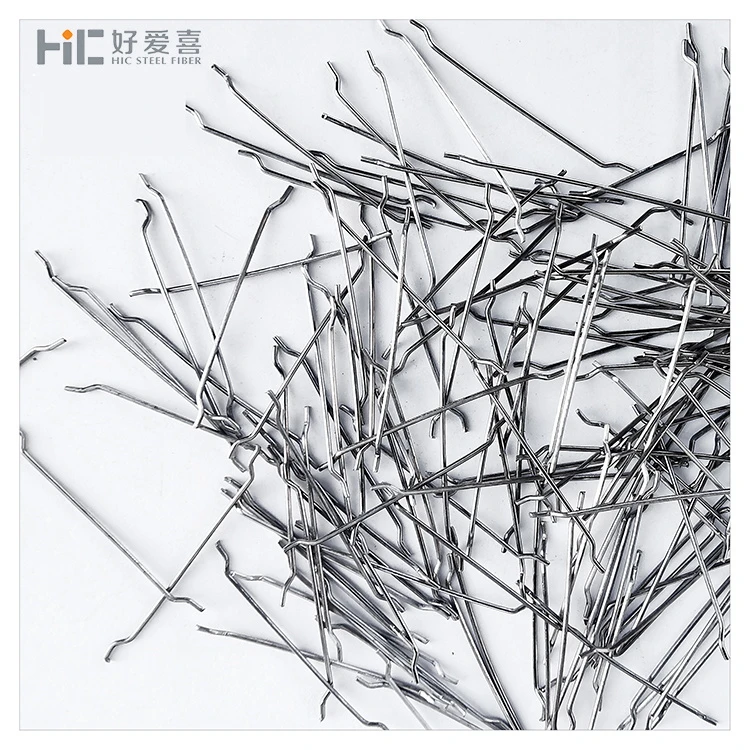
The end hook steel fiber is mainly used in the manufacture of steel fiber concrete, and the steel fiber produced by any method can play a role in strengthening the concrete. Its impact strength, toughness, impact toughness and other properties have been greatly improved. The long straight steel fiber of the section has a length of 10-60 mm, a diameter of 0.2-0.6 mm, and an aspect ratio of 50-100. In addition, other shapes of products can also be selected. Common steel fibers are indented, wavy, hooked, big-headed, and twisted according to their shapes, which are relatively common in architecture. According to the production process, it is divided into cutting type, shearing type, milling type and melting type.
At present, the main problem in the application of steel fiber reinforced concrete is the high production cost of steel fiber, resulting in a high initial cost of steel fiber reinforced concrete. In order to make steel fiber reinforced concrete widely used, on the one hand, efforts should be made to reduce the production cost of steel fiber and thus the cost of steel fiber reinforced concrete; Comprehensive economic benefits such as superior performance, lower maintenance costs and extended service life. Due to the strict requirements on the control of water-cement ratio when mixing steel fiber reinforced concrete, it is not suitable for construction in rainy weather or strong wind conditions. It should be carried out when the weather is fine and fine, the construction must be stopped in case of rain, and the unhardened concrete bridge deck should be covered with geotextiles in time. If necessary, a temporary construction rain shelter can be built, and the remaining work can be completed as soon as possible under the rain shelter. Under high temperature or strong wind conditions, the spraying amount of the health agent should be adjusted in time. After spraying the health agent, the geotextile should be covered in time. After the concrete is initially set, sprinkle water on the geotextile to moisten it to prevent shrinkage and cracking of the bridge deck concrete.