

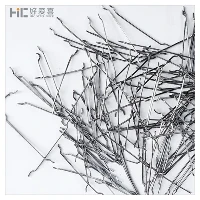

Loose hooked end steel fiber is a popular material widely used in various construction and industrial applications. As a leading supplier of loose hooked end steel fiber, I am often asked about its chemical composition. Understanding the chemical makeup is crucial as it directly impacts the fiber's performance and suitability for different projects.
Primary Chemical Components
The main chemical component of loose hooked end steel fiber is iron (Fe). Iron forms the base of the steel, providing its structural integrity. In high - quality steel fibers, iron typically makes up a significant portion of the composition, usually more than 90%. The presence of iron gives the fiber its strength and durability, allowing it to reinforce concrete and other composite materials effectively.
Another important component is carbon (C). Carbon is added in small amounts, usually ranging from 0.1% to 1.5%. The amount of carbon has a profound impact on the mechanical properties of the steel fiber. A higher carbon content generally increases the hardness and strength of the fiber but may also reduce its ductility. For loose hooked end steel fibers, a carefully balanced carbon content is chosen to ensure a combination of strength and flexibility. This allows the fibers to withstand the stresses and strains during the mixing, placing, and curing of concrete without breaking or deforming prematurely.
Alloying Elements
In addition to iron and carbon, several alloying elements are often added to enhance the performance of loose hooked end steel fiber.
Manganese (Mn) is one of the commonly used alloying elements. It helps to improve the hardenability and toughness of the steel. Manganese also acts as a deoxidizer during the steel - making process, removing oxygen and sulfur impurities that can weaken the steel. Typically, the manganese content in steel fibers ranges from 0.3% to 1.5%.
Silicon (Si) is another important alloying element. It is added to increase the strength and hardness of the steel. Silicon also helps in improving the steel's resistance to oxidation and corrosion. In loose hooked end steel fibers, the silicon content is usually in the range of 0.1% to 0.5%.
Chromium (Cr) may be added in some cases, especially when enhanced corrosion resistance is required. Chromium forms a passive oxide layer on the surface of the steel, protecting it from rust and other forms of corrosion. The chromium content can vary depending on the specific application, but it is generally in the range of 0.5% to 2%.
Impurities and Their Effects
Although efforts are made to keep the steel fiber as pure as possible, some impurities may still be present. Sulfur (S) and phosphorus (P) are two common impurities. Sulfur can form iron sulfide (FeS) inclusions, which can reduce the ductility and toughness of the steel. Phosphorus, on the other hand, can increase the brittleness of the steel, especially at low temperatures. Therefore, the content of sulfur and phosphorus in high - quality loose hooked end steel fibers is strictly controlled, usually kept below 0.05%.
Impact of Chemical Composition on Performance
The chemical composition of loose hooked end steel fiber directly affects its mechanical properties and performance in different applications.


The strength of the fiber is mainly determined by the carbon content and the presence of alloying elements such as manganese and silicon. A higher carbon content and appropriate alloying can result in a stronger fiber, which is essential for applications where high - strength reinforcement is required, such as in high - rise buildings and heavy - duty industrial floors.
The corrosion resistance of the fiber is influenced by the presence of elements like chromium. In environments where the steel fiber is exposed to moisture, chemicals, or salt, fibers with a higher chromium content are preferred to prevent rusting and ensure long - term durability.
The ductility of the fiber is also an important factor. A fiber with good ductility can bend and stretch without breaking, which is beneficial during the concrete mixing process and when the concrete is subjected to dynamic loads. The carbon content and the balance of alloying elements play a crucial role in determining the fiber's ductility.
Our Product Offerings
As a supplier of loose hooked end steel fiber, we offer a wide range of products with different chemical compositions to meet the diverse needs of our customers. Our Low Carbon Steel Fiber is designed for applications where high ductility is required, such as in pre - cast concrete products. The low carbon content ensures that the fibers can be easily bent and shaped without cracking.
Our Cold Drawn Steel Wire Fibre is produced through a cold - drawing process, which further enhances its strength and uniformity. The precise control of the chemical composition during the manufacturing process results in fibers with excellent mechanical properties, making them suitable for use in demanding applications like shotcrete.
For commercial and industrial floors, we recommend our Steel Fiber for Commercial and Industrial Floor. These fibers are specifically formulated to provide high - strength reinforcement, wear resistance, and crack control. The optimal chemical composition ensures that the fibers can effectively distribute loads and prevent the formation of cracks, extending the service life of the floors.
Conclusion
In conclusion, the chemical composition of loose hooked end steel fiber is a complex combination of iron, carbon, alloying elements, and controlled impurities. Each component plays a vital role in determining the fiber's strength, ductility, corrosion resistance, and other mechanical properties. As a supplier, we understand the importance of providing high - quality steel fibers with the right chemical composition for different applications.
If you are interested in our loose hooked end steel fiber products or have any questions about their chemical composition and suitability for your projects, we encourage you to contact us for more information and to discuss your procurement needs. Our team of experts is always ready to assist you in finding the best solution for your specific requirements.
References
- ASM Handbook Committee. (2008). ASM Handbook, Volume 1: Properties and Selection: Irons, Steels, and High - Performance Alloys. ASM International.
- Neville, A. M. (2011). Properties of Concrete. Pearson Education.
- Malhotra, V. M., & Mehta, P. K. (2005). Concrete: Microstructure, Properties, and Materials. McGraw - Hill.