

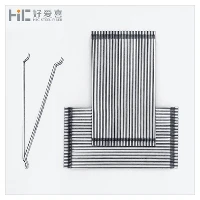
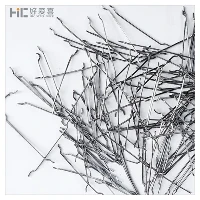
Hey there! I'm a supplier of Cold Drawn Steel Wire Fibre, and today I want to chat about how this awesome product affects the thermal conductivity of concrete.


First off, let's understand what Cold Drawn Steel Wire Fibre is. It's a type of steel fiber that's made through a cold - drawing process. This process gives the fiber its unique properties, like high strength and good ductility. You can find out more about it on our website: Cold Drawn Steel Wire Fibre.
Now, onto thermal conductivity. Thermal conductivity is a measure of how well a material can conduct heat. In the case of concrete, it's an important property, especially in buildings where energy efficiency is a big deal. When the thermal conductivity of concrete is too high, it means more heat can transfer through the walls, floors, or ceilings, which can lead to higher energy consumption for heating or cooling.
So, how does Cold Drawn Steel Wire Fibre fit into all of this? Well, steel has a relatively high thermal conductivity compared to concrete. When we add Cold Drawn Steel Wire Fibre to concrete, it creates a network of conductive paths within the concrete matrix.
Let's start with the positive aspects. One of the benefits is that the steel fibers can help in distributing heat more evenly throughout the concrete. This can be really useful in situations where you want to prevent localized over - heating or cooling. For example, in industrial floors where there might be heat sources concentrated in one area, the steel fibers can spread the heat, reducing the risk of thermal stress cracking.
However, there's also a flip side. Since steel conducts heat better than concrete, adding too much Cold Drawn Steel Wire Fibre can potentially increase the overall thermal conductivity of the concrete. This might not be ideal in buildings where you're aiming for high - performance insulation. So, it's all about finding the right balance.
When it comes to the amount of fiber, the volume fraction plays a crucial role. A low volume fraction of Cold Drawn Steel Wire Fibre, say around 0.5% - 1%, might have a minimal impact on the thermal conductivity of concrete. In fact, it can still provide the benefits of improved strength and crack resistance without significantly altering the heat - transfer properties. But as we increase the volume fraction to 2% or more, the thermal conductivity starts to rise more noticeably.
The aspect ratio of the fibers also matters. Fibers with a high aspect ratio (length to diameter ratio) tend to create more continuous conductive paths within the concrete. This means that they can have a greater influence on the thermal conductivity compared to fibers with a lower aspect ratio.
Another factor is the distribution of the fibers. If the Cold Drawn Steel Wire Fibre is evenly distributed throughout the concrete, it can have a more predictable effect on the thermal conductivity. On the other hand, if the fibers are clumped together, it can create areas of higher conductivity, leading to uneven heat transfer.
Let's talk about some practical applications. In pre - cast concrete elements, Cold Drawn Steel Wire Fibre can be used to enhance the strength while still controlling the thermal conductivity. By carefully selecting the fiber dosage and characteristics, we can ensure that the pre - cast elements meet the required thermal performance standards.
In mass concrete structures, like dams or large foundation slabs, the addition of Cold Drawn Steel Wire Fibre can help in managing the heat generated during the hydration process. The fibers can assist in dissipating the heat more evenly, reducing the risk of thermal cracking.
Now, if you're in the market for high - quality steel fibers, we also offer Wear Resistant Hooked End Steel Fiber. These fibers are great for applications where wear resistance is a key concern, such as in industrial pavements or bridge decks. And for those projects where you need fibers with a specific diameter, our Diameter Matching Hooked End Steel Fiber is the perfect choice.
We understand that every project is unique, and that's why we're here to work with you to find the best solution for your concrete needs. Whether you're looking to improve the strength, crack resistance, or manage the thermal conductivity of your concrete, our Cold Drawn Steel Wire Fibre can be a game - changer.
If you're interested in learning more about our products or discussing a potential project, don't hesitate to reach out. We're always happy to have a chat and help you make the right choice for your construction needs. Let's work together to create stronger, more durable, and energy - efficient concrete structures!
References:
- "Concrete Technology: Properties, Materials, and Mix Design" by H. K. Khanna
- "Fiber - Reinforced Concrete: Mechanics, Design, and Applications" by V. C. Li and B. C. Gerstle